Infrastructure Built Around
Your Requirements
Standard server plans work for most businesses, but enterprise operations run on compliance requirements, multi-region redundancy, unpredictable scale, and applications where an hour of downtime has a real number attached to it. An enterprise dedicated server is hardware and support built around your specific requirements rather than a fixed tier you have to fit yourself into.
Infrastructure Built Around Your Requirements, Not a Template
At this level, the conversation isn't about which plan to pick off a pricing page. It's what your infrastructure actually needs, and building a server configuration around that answer.
What Makes a Server "Enterprise Grade"
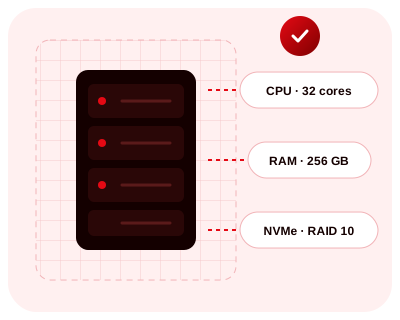
An enterprise grade dedicated server isn't defined by a single spec. It's defined by how the entire configuration is built to handle scale, redundancy, and risk simultaneously.
Enterprise vs Standard Dedicated Hosting
| Factor | Enterprise Dedicated Server | Standard Dedicated Server |
|---|---|---|
| Configuration | Fully custom, built to spec | Fixed plan tiers |
| Redundancy | Multi-layer, built in | Varies by plan |
| Support model | Dedicated account manager | General support team |
| SLA | Negotiated to your requirements | Standard published SLA |
| Scaling | Planned around projected growth | Manual upgrade per tier |
The core hardware isn't necessarily more powerful in every case. It's the surrounding infrastructure, support structure, and guarantees that shift. If a fixed tier fits your workload, our standard dedicated servers or a managed dedicated server may be all you need.
Built for Scale From the Start
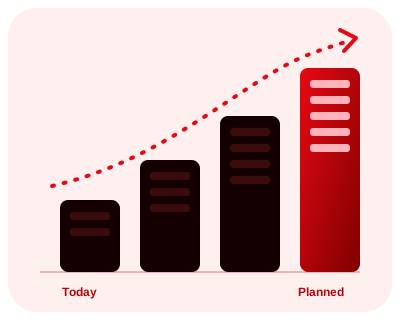
A scalable dedicated server matters most when growth isn't linear or predictable. Rather than sizing a server for today's traffic and hoping it holds, enterprise configurations are typically planned with headroom and a defined upgrade path, so scaling up doesn't mean an emergency migration during a traffic spike. This is where a dedicated server for large business differs most from a standard plan: the growth conversation happens at setup, not after something breaks.
Who This Level of Infrastructure Actually Fits
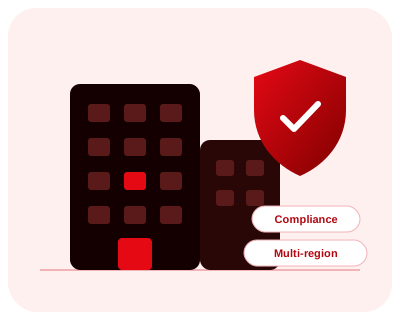
This isn't the right starting point for most projects, and it isn't meant to be. It fits organizations running compliance-sensitive data, platforms with unpredictable or rapidly growing traffic, businesses operating across multiple regions with redundancy requirements, and companies where the cost of downtime justifies infrastructure built specifically to prevent it. If your current hosting decisions are being made by a procurement or compliance team rather than just an engineer, this is usually the right tier to be looking at.
Getting a Custom Configuration Built
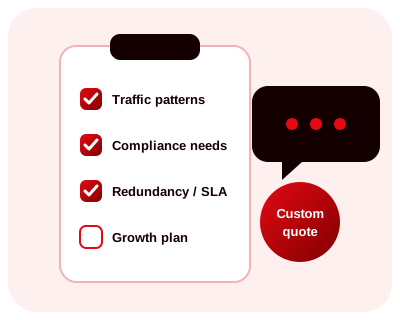
A custom enterprise dedicated server starts with a conversation about your actual infrastructure, not a plan selector. Traffic patterns, compliance obligations, redundancy expectations, and growth projections all shape what gets built. Reach out for enterprise dedicated server price details specific to your configuration, since standard tier pricing doesn't really apply here.