The Open-Source
Standard for VPS Hosting
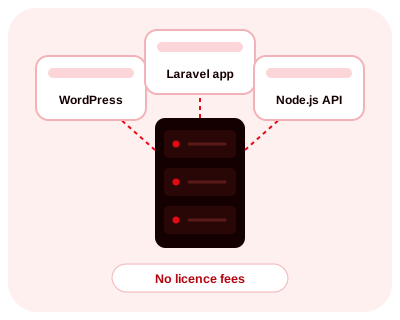
Linux powers most of the Internet — reliable, versatile, and free of licensing fees. A Linux VPS gives you a virtual server built on the operating system that runs most of the web's applications, databases and dev environments, without locking you into any one vendor's ecosystem. Pick your distribution; we handle the hardware.
Pick Your Distribution
Linux isn't a single OS — it's a family. Choose the distro that fits your workflow; the hardware, root access and resource allocation stay the same either way.
What You Get With Every Plan
Why Developers Prefer Linux VPS
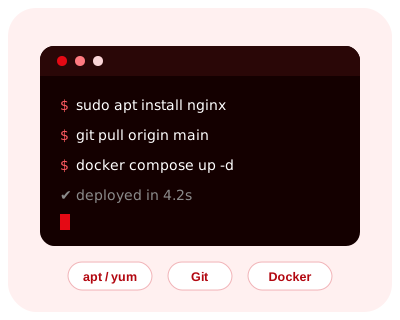
A Linux VPS means fewer restrictions and more familiar tools. Package managers like apt and yum make software installs painless, most open-source frameworks assume Linux as the underlying platform, and shell scripting behaves exactly as it does on your local machine. If your workflow relies on Git, Docker, or shell scripts for deployment, Linux removes friction that other operating systems tend to add back in.
Linux VPS Hosting Plans
Every plan runs on SSD Linux VPS technology — performance scales with resource allocation, not storage type.
| Plan | RAM | Storage | CPU Cores | Bandwidth | Best For | |
|---|---|---|---|---|---|---|
| Linux VPS Lite | 1 GB | 25 GB SSD | 1 vCore | 1 TB | Personal projects, testing | Get Started |
| Linux VPS Standard | 2 GB | 50 GB SSD | 2 vCores | 3 TB | Blogs, small business sites | Get Started |
| Linux VPS Plus | 4 GB | 100 GB SSD | 4 vCores | 5 TB | Web apps, growing traffic | Get Started |
| Linux VPS Max | 8 GB | 200 GB SSD | 6 vCores | 10 TB | High-traffic sites, dev teams | Get Started |
Want pricing across all our Linux VPS plans? Contact us for details.
KVM Virtualization for Every Server
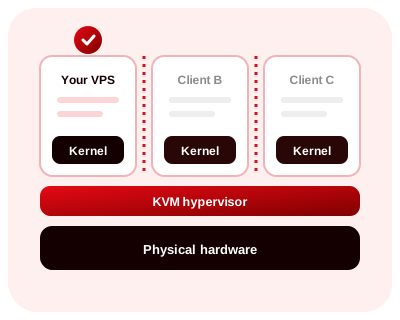
All our Linux KVM VPS plans use full hardware virtualization, not a shared kernel. Each server runs independently with its own kernel and is completely isolated from other clients on the same hardware — the same virtualization technology behind our managed and unmanaged Linux platforms, with the OS layer fully under your control.
Linux VPS Is Ideal If…
Your application runs on open-source software, doesn't require licensing fees, and needs the low-level control Linux provides. It's a great fit for agencies managing client websites, developers working on personal or client projects, and businesses that want a server environment they already know how to manage.