Starting a hosting business used to mean buying racks of servers, hiring a network engineer, and writing your own billing system. Today you can launch in a weekend. You rent a reseller plan, connect a billing platform, put your own brand on the front, and start selling.
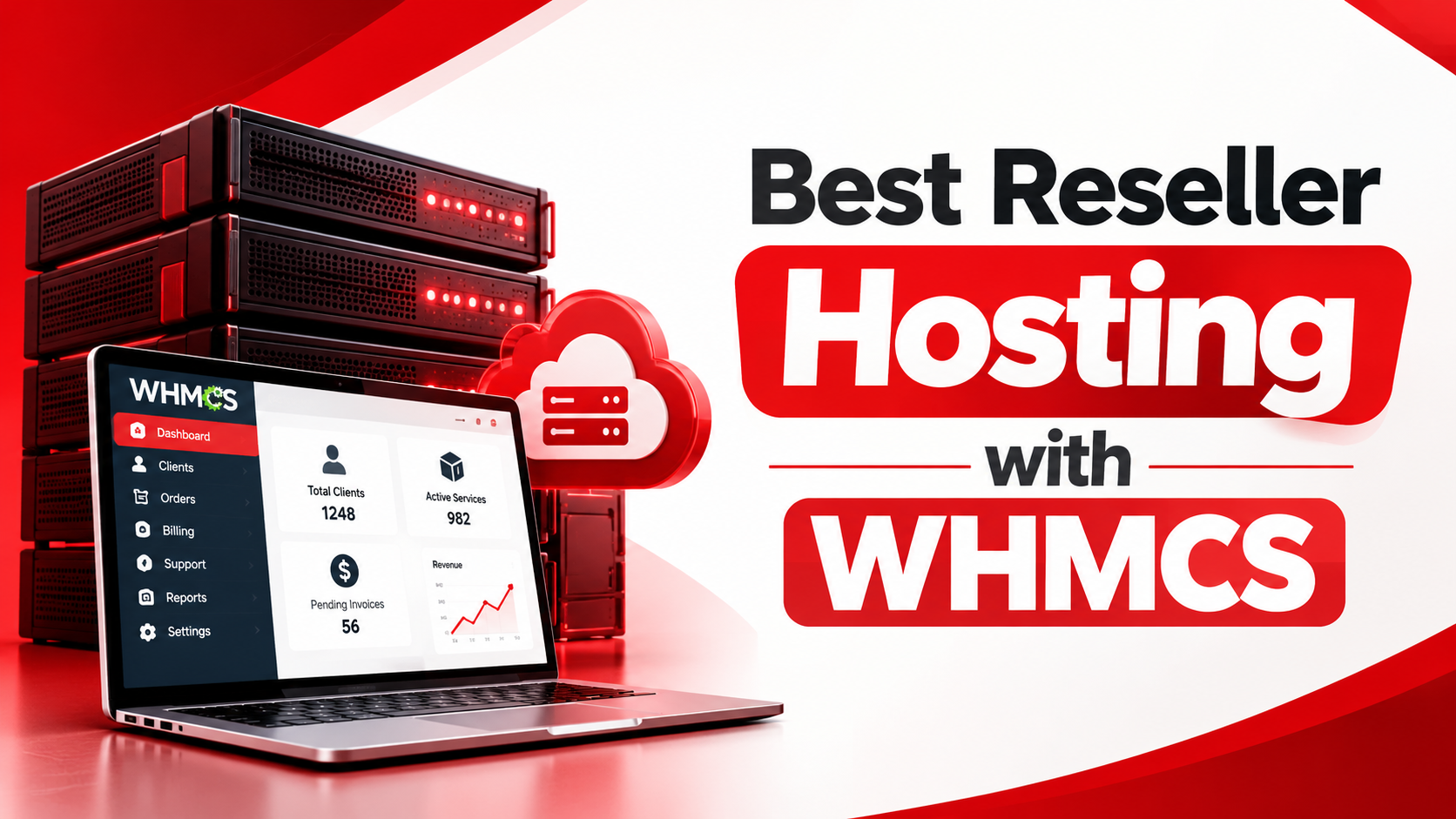
The billing platform is where many new resellers go wrong. A reseller plan without automation turns into a second job: chasing invoices, creating accounts by hand, and answering “where’s my login?” emails at midnight. That’s why WHMCS has become the default choice for serious resellers. It handles invoicing, provisioning, domain sales, support tickets, and renewals from one dashboard.
This guide covers what makes a reseller hosting plan with WHMCS good, which features matter, which red flags to avoid, and how to pick a provider you won’t outgrow in six months.
What Is Reseller Hosting, in Plain English?
With reseller hosting, you buy a large block of server resources (disk space, bandwidth, and the right to create many cPanel accounts) from a hosting company. You split that block into smaller packages and sell them to your own customers under your own brand, at your own prices.
Your customers never need to know who owns the hardware. They see your name, your website, your invoices, and your support. The host handles the server, the security patches, and the hardware failures behind the scenes.
It suits web designers, freelance developers, digital agencies, and anyone who already manages websites for clients. If you build ten sites a year and each client asks “who will host it?”, reseller hosting turns that question into monthly recurring income.
If you’re comparing this route against running your own server, our guide on reseller vs VPS hosting explains when each model makes sense.
Why WHMCS Is the Billing Platform Resellers Rely On
WHMCS (Web Host Manager Complete Solution) is billing and client-management software built for hosting companies. Here is what it does for a reseller.
Automated provisioning. When a customer pays, WHMCS tells WHM to create the cPanel account right away. No manual setup and no waiting for you to wake up.
Recurring invoices and reminders. Invoices are generated before renewal dates, reminders go out automatically, and overdue accounts can be suspended without you lifting a finger. For a small business, this alone saves hours every week.
Domain registration and renewals. You can sell domains through the same checkout as hosting. Customers buy a package in one transaction, and you earn margin on both.
A built-in support desk. Tickets, departments, canned replies, and a knowledge base are all included. Your business looks established from day one, even if it’s only you behind the desk.
Payment gateway flexibility. WHMCS connects to most major payment processors, so you can accept cards, PayPal, bank transfers, and regional options, which matters if your customers are spread across countries.
A client area with your branding. Customers log in to a portal that carries your logo and colors, not a generic template. That is the heart of white-label hosting.
Without WHMCS, you’d stitch these functions together from separate tools. It works, but it breaks at the worst moments, usually when you’re trying to scale.
The Features That Separate a Great Reseller Plan from a Mediocre One
Every host claims to offer “the best reseller hosting.” Here is how to see past the marketing.
1. WHM and cPanel Included
cPanel is the control panel your customers already know, and for many buyers it’s a trust signal. WHM, the reseller-side interface, lets you create packages, manage accounts, set resource limits, and handle DNS. Make sure both come with the plan, not as paid add-ons.
2. Free or Fairly Priced WHMCS
WHMCS licensing is a real cost. Some hosts charge you separately for it, which adds up quickly when you’re starting out. Others include it with higher-tier plans. Globalink, for example, includes free WHMCS on its Pro and above reseller tiers, and you can read how it works on the WHMCS billing page. When comparing prices, always add the license cost to the monthly fee for a true figure.
3. Real White-Labeling
White-label means your customers never see the parent host’s name. That covers private nameservers, your own branded client area, and no logos or links leading back to your supplier. If a plan can’t do this cleanly, you’re only a middleman with a thin disguise. Look for a provider with a dedicated white label hosting setup so your brand stays front and center.
4. Account Isolation
This is the most overlooked feature in reseller hosting. On a poorly configured server, one customer’s runaway script or hacked WordPress site can slow down everyone else, including your best clients. CloudLinux isolation gives every account its own resource boundary, so a noisy neighbor can’t drag down the rest. If a provider doesn’t mention isolation at all, ask them directly.
5. NVMe SSD Storage
Storage speed shapes how fast your customers’ sites feel. NVMe drives are noticeably quicker than older SATA SSDs, and speed directly affects bounce rates and search rankings. In 2026, NVMe should be the baseline, not a premium feature.
6. Uptime You Can Point To
A 99.9% uptime guarantee allows roughly 43 minutes of downtime a month. That’s an acceptable standard for most small businesses. What matters more is how the host responds when something goes wrong, which brings us to support.
7. Support That Backs You Up
As a reseller, you’re the first line of support for your customers, but you need a second line behind you. Look for 24/7 access by chat, phone, and ticket, and test it before you buy. Send a pre-sales question and see how quickly you get a real answer. If a host is slow when they want your money, they’ll be slower once they have it.
8. Free Migration
If you already host client sites somewhere else, moving them is the scariest part of switching. A host that offers free migration with minimal downtime removes that barrier. It also lets you onboard new customers who are leaving their old provider, which is a strong selling point for your own business.
9. Room to Scale
Today you have 15 customers. In two years you may have 150. Choose a provider with a clear upgrade path, ideally one where you can move from reseller to VPS hosting or a dedicated server without switching companies. Staying under one roof keeps billing simple and migrations painless.
Common Mistakes New Resellers Make
Choosing purely on price. The cheapest plan often hides tight inode limits, oversold servers, or support that takes two days to reply. Your reputation sits on top of their infrastructure, so a bargain that causes outages isn’t a bargain.
Ignoring the license cost. A low monthly plan that charges extra for WHMCS and extra again for an SSL manager can end up pricier than an all-inclusive offer.
Skipping the legal basics. You’ll need terms of service, an acceptable use policy, and a privacy policy. WHMCS lets you display these at checkout, so use that.
Underpricing. Many beginners charge so little that they can’t afford to support their customers properly. You’re selling reliability, convenience, and service, not just disk space. Price accordingly.
Not planning for support. Customers don’t judge you by uptime alone. They judge you by how fast and how kindly you answer when something breaks.
How to Evaluate a Reseller Host in Five Steps
- List your needs. How many customers do you expect in the first year? What kind of sites will you host: simple brochure sites, WordPress, or WooCommerce stores? Your answers set the minimum resources you need.
- Check what’s included. Make a simple table: WHM, cPanel, WHMCS, SSL, backups, isolation, private nameservers. Mark what’s included and what costs extra.
- Read the fair-use terms. “Unlimited” almost always has fine print. Know exactly what the limits are on CPU, memory, and inodes.
- Test support. Open a chat or ticket with a technical question. Notice the speed and the quality of the answer.
- Start with a plan you can upgrade. It’s far easier to scale up inside the same company than to migrate everything later.
What Globalink Offers for Resellers
If you’re weighing options, here is how Globalink’s reseller hosting lines up with the checklist above. Plans start from $17 a month and include WHM and cPanel, unlimited accounts, white-label readiness, and free WHMCS on Pro and above tiers. Servers run on NVMe SSD storage with CloudLinux isolation, and every hosting plan includes free SSL, free migration, and a 99.9% uptime SLA. Support is available around the clock by phone, chat, and ticket.
Because the same company also sells domains, VPS, and dedicated servers, you can grow without changing providers. Start on reseller hosting, and when your customer base outgrows it, move to a managed or unmanaged VPS inside the same ecosystem.
You can also attach extra revenue streams to the same customers. Domain registration and Google Workspace are natural upsells, since most small businesses need a professional domain and branded email alongside their website. Selling .pk domains to local clients is another useful angle, and you can see the options on the .PK domain registration page.
Reseller Hosting vs Other Options: A Quick Comparison
Reseller hosting isn’t the only way to get into the business, and it’s worth knowing the alternatives.
Shared hosting is cheaper but gives you no way to resell. It’s meant for a single website or small business. See our comparison of shared vs VPS hosting if you’re unsure which fits your project.
VPS hosting gives you full root access and dedicated resources. You can run your own control panel, install WHMCS yourself, and customize everything. It offers more control, but you also take on server administration, security updates, and troubleshooting. It’s a strong fit once you have technical skills or a growing customer base. Compare it with a dedicated server as you scale further.
Reseller hosting sits in the middle: easy to start, little technical overhead, and a clear path to growth. For most beginners, it’s the right first step.
Pricing Your Own Hosting Packages
Once you’ve chosen a provider, you need to decide what to charge. Here are some practical guidelines.
Know your cost per customer. Divide your monthly reseller fee and WHMCS license cost by the number of accounts you realistically plan to host. That gives you a floor price.
Build three tiers. A starter plan, a standard plan, and a premium plan usually work well. Most buyers pick the middle option, so make sure it’s the one that earns you the best margin.
Sell value, not specs. Customers don’t care how many gigabytes of storage they’re getting. They care about whether their site will be fast, secure, and looked after. Talk about backups, migration help, and support response times.
Offer annual billing. A small discount for yearly payments improves your cash flow and reduces churn. WHMCS makes it simple to offer multiple billing cycles.
Bundle services. Hosting plus a domain plus professional email is more attractive, and more profitable, than any one of them alone.
Getting Your WHMCS Setup Right from Day One
A few tips can save you headaches later:
- Set up your branding first. Add your logo, colors, and company details before you take your first order.
- Write clear product descriptions. Customers should understand what they’re buying without having to ask.
- Automate everything you can. Auto-provisioning, automatic invoice reminders, and automatic suspension rules keep your workload manageable.
- Create canned support replies. Answers to common questions, such as DNS changes, email setup, and password resets, save hours.
- Build a knowledge base. Every article you write now means fewer tickets later.
- Test your own checkout. Place a test order and walk through the process as a customer would. Broken checkouts quietly cost sales.
For a deeper look at how billing and provisioning fit together, visit our WHMCS billing overview, and browse the Globalink blog for more practical guides.
Frequently Asked Questions
Do I need technical skills to start a reseller hosting business?
Basic familiarity with websites and domains helps, but you don’t need to be a server expert. WHM and WHMCS are designed to be managed through a point-and-click interface, and a good host handles the server-level work.
Is WHMCS necessary, or can I bill manually?
You can bill manually for a handful of clients, but it doesn’t scale. Automation is what lets you grow beyond a few customers without burning out.
How many customers do I need to be profitable?
That depends on your costs and pricing, but many resellers reach break-even with a small number of customers. Because your costs are mostly fixed, every additional account adds margin.
What happens if I outgrow my reseller plan?
Choose a host that offers an upgrade path. With Globalink, you can move to a VPS or dedicated server under the same account.
Can I move my existing customers to a new host?
Yes. With free migration, the host’s team transfers the sites for you, ideally with no downtime.
Final Thoughts
The best reseller hosting with WHMCS isn’t necessarily the cheapest or the one with the biggest numbers on its pricing page. It’s the one that gives you the tools to look professional, automate the dull parts, and stay online when your customers need you. Prioritize real white-labeling, account isolation, fast NVMe storage, responsive support, and billing that works without constant babysitting.
If you’re ready to launch, explore Globalink’s reseller hosting plans, or contact the team with questions about which tier fits your plans. A good starting point and a clear path to grow are what turn a side project into a real hosting business.