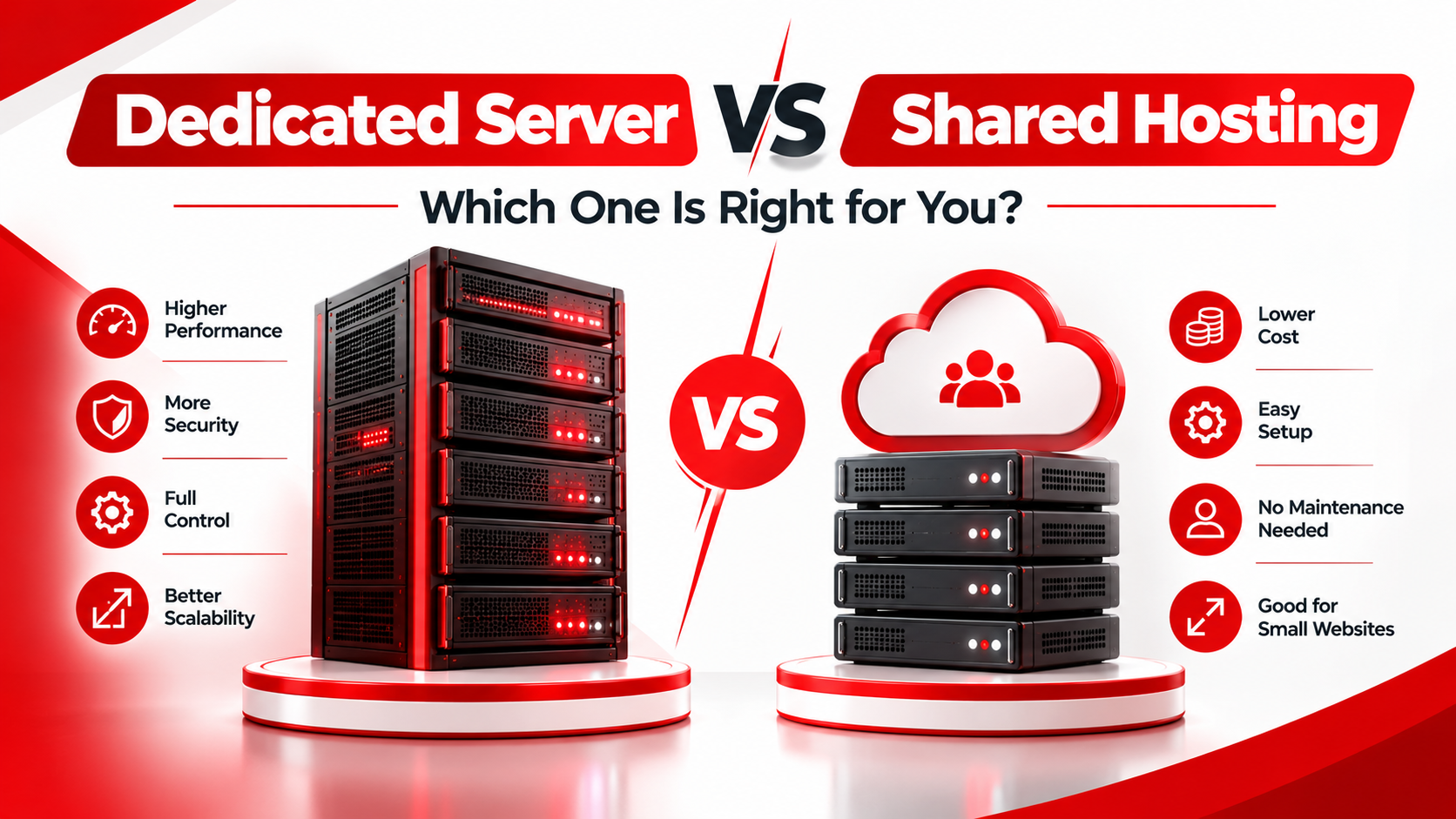
Choosing a hosting type feels like a technical decision, but it’s really a business one. The plan you pick affects how fast your pages load, how well your site handles a traffic spike, how safe your data is, and how much you pay every month.
Two options sit at opposite ends of the spectrum: shared hosting and dedicated servers. One is cheap and simple. The other is powerful and exclusive. Neither is better in every situation, and the trick is knowing which one matches where your website is today and where it’s heading.
This guide explains how each works, where each shines, where each falls short, and how to decide.
What Is Shared Hosting?
Shared hosting means many websites live on a single physical server and split its resources: CPU, memory, storage, and bandwidth. The hosting company manages the hardware, the operating system, security updates, and the control panel. You upload your site and get on with running your business.
Think of it like renting an apartment in a large building. You have your own space and your own key, but the plumbing, electricity, and structure are shared and maintained by the landlord. It’s affordable because the cost of the building is divided among many tenants.
Shared hosting is where most websites begin: personal blogs, portfolios, small business sites, local service pages, and starter online shops.
Good providers use isolation technology so that one tenant’s problems don’t spill over into another’s. Globalink’s shared plans run on NVMe SSD storage with CloudLinux isolation, which gives each account its own protected resource boundary. You can browse the full range on the web hosting page.
Advantages of Shared Hosting
Low cost. It’s the most affordable way to get a site online with a real hosting company behind it.
Easy to use. With cPanel, you can install WordPress, create email accounts, manage files, and set up databases without touching a command line. See our cPanel hosting options for a familiar, beginner-friendly dashboard.
No server management. The provider handles updates, patches, monitoring, and hardware issues.
Quick setup. Plans activate quickly, so you can have a site live within minutes of ordering.
Bundled extras. Free SSL, free migration, and a free domain often come with the plan, which keeps your first-year costs low.
Disadvantages of Shared Hosting
Limited resources. You can’t use unlimited CPU or memory, and “unlimited” marketing usually comes with fair-use limits.
Less customization. You can’t install custom server software or change core configuration settings.
Performance ceiling. Even with good isolation, a very busy site can outgrow what a shared account allows.
Shared IP address. In most cases, you share an IP with other sites, which can occasionally matter for email reputation.
What Is a Dedicated Server?
A dedicated server is an entire physical machine reserved for you alone. Nobody else shares its processor, memory, disks, or network port. You decide what runs on it, how it’s configured, and how its resources are used.
Going back to the housing analogy, a dedicated server is owning a whole house. You have complete privacy, total control, and plenty of room. You also take on more responsibility and a higher bill.
Dedicated servers typically suit large ecommerce stores, high-traffic media sites, SaaS platforms, game servers, and businesses with strict compliance or performance requirements. Globalink’s dedicated servers use Intel Xeon processors, RAID 1 storage, and a 1 Gbps network, with instant provisioning, starting from $106 a month.
Advantages of a Dedicated Server
Maximum performance. All the power belongs to you. There are no neighbors, no competing processes, and no resource contention.
Full control. You choose the operating system, the software stack, and the security rules. Custom applications that won’t run on shared hosting are no problem.
Strong isolation and security. Because no one else is on the machine, you avoid risks that come from sharing. You can also build a security setup around your own requirements.
Dedicated IP and network capacity. You get a stable address and a generous connection, which helps with email deliverability and heavy traffic.
Predictable behavior. Performance doesn’t fluctuate because of someone else’s traffic spike.
Reliability features. RAID configurations protect against a single drive failure, keeping your data safer.
Disadvantages of a Dedicated Server
Higher cost. It’s the most expensive of the common hosting options, which is a serious consideration for small budgets.
Technical responsibility. Unless you choose a managed service, you handle updates, security, and troubleshooting yourself.
Overkill for small sites. A site with modest traffic wastes most of the power it pays for.
If you’d like the benefits without the workload, Globalink also offers a managed dedicated server where the team handles maintenance, and an enterprise tier for larger and more demanding deployments.
Dedicated Server vs Shared Hosting: Side-by-Side
Here is how the two compare on the points that matter most.
Performance. Shared hosting is fine for light to moderate traffic. A dedicated server handles heavy loads, large databases, and demanding applications with ease.
Cost. Shared hosting costs a small fraction of a dedicated server. For many beginners, this alone settles the question.
Control. Shared hosting restricts what you can change. A dedicated server gives you root-level control of everything.
Security. Both can be secure. Shared hosting depends on the provider’s isolation and patching. A dedicated server lets you design and enforce your own security measures, but you’re also responsible for them.
Scalability. Shared plans can be upgraded within limits. A dedicated server offers a much higher ceiling, though adding capacity may mean changing hardware.
Technical skill needed. Shared hosting requires almost none. A dedicated server needs real system administration knowledge, unless it’s managed.
Setup time. Shared plans activate in minutes. Dedicated servers can also be provisioned quickly with a good provider, but configuration takes more effort.
Best for. Shared hosting suits blogs, portfolios, small business sites, and new stores. Dedicated servers suit high-traffic, resource-intensive, or compliance-driven projects.
The Middle Option You Shouldn’t Ignore: VPS Hosting
Many people see this as a two-way choice, but there’s an important step in between. A virtual private server (VPS) divides one physical machine into several isolated virtual machines, each with guaranteed resources and root access.
A VPS gives you far more control and consistency than shared hosting, at a much lower price than a dedicated server. It’s often the right move when your site outgrows shared hosting but doesn’t yet justify an entire machine.
Globalink’s VPS hosting starts from $12 a month and includes NVMe SSD storage, guaranteed RAM and CPU, and full root access. Depending on your needs, you can choose Performance VPS, Core VPS, Linux VPS, or Windows VPS. Whether you want to handle the server yourself or not, there are managed and unmanaged versions.
For a closer look at the next step up, read our comparison of VPS vs dedicated hosting, and if you’re moving from the bottom rung, our guide to shared vs VPS hosting will help.
Signs You Should Stay on Shared Hosting
Shared hosting is still the right answer if:
- Your site gets modest traffic, such as a few thousand visits a month
- You run a blog, portfolio, brochure site, or small WordPress site
- You’re just launching and want to keep costs low
- You don’t have technical staff or the time to manage a server
- Your site doesn’t use heavy custom software
- Your pages load quickly and you aren’t hitting resource limits
Paying for a dedicated server before you need one is one of the most common ways small businesses waste money.
Signs You Should Move to a Dedicated Server
It may be time to upgrade when:
- Your site slows down during busy periods, even after optimization
- You regularly see resource-limit warnings or errors
- You run a large online store with thousands of products and constant orders
- Your application needs a custom operating system or specialized software
- You handle sensitive data and need tighter control over security and compliance
- You want a dedicated IP and complete freedom over email and network settings
- Downtime directly costs you serious revenue
If several of these sound familiar, shared hosting is probably holding you back. Consider whether a VPS solves the problem first, and if it doesn’t, a dedicated server is the logical step.
Common Mistakes When Choosing Between the Two
Choosing by price alone. The cheapest plan can cost you more through slow speeds and lost customers. On the other hand, overpaying for power you’ll never use hurts too.
Upgrading too late. Many owners wait until the site crashes. Watch your performance trends and plan ahead.
Upgrading too early. A dedicated server won’t fix a slow site caused by uncompressed images, bloated plugins, or poor code. Optimize first.
Ignoring management needs. A dedicated server without anyone to manage it is a liability. If you don’t have technical expertise, choose a managed option.
Forgetting about backups. Neither type of hosting removes the need for backups. Confirm what’s included and test restores occasionally.
Overlooking support quality. When something breaks, you’ll want fast, knowledgeable help. Choose a provider with 24/7 support by phone, chat, and ticket.
What to Check With Any Provider
Before you commit, ask:
- What storage technology is used? NVMe is faster than older drives.
- Is isolation in place on shared plans?
- What uptime does the provider guarantee?
- Is support really available around the clock?
- Is migration free if you’re moving an existing site?
- Is a free SSL certificate included?
- How easy is it to upgrade later without downtime?
- What does the plan cost at renewal?
Globalink’s answers are clear: NVMe SSD storage, CloudLinux isolation, a 99.9% uptime SLA, 24/7 live support, free migration, free SSL on every hosting plan, and a growth path from shared hosting to VPS to dedicated servers under one roof.
Don’t Forget the Rest of Your Setup
Hosting is only one part of your online presence. A few related pieces are worth planning at the same time:
- Your domain. Register a clear, memorable name through domain registration and add WHOIS privacy to keep your details out of public records.
- Business email. Professional addresses build trust. Google Workspace is a dependable option.
- Your store. If you’re selling online, a dedicated ecommerce hosting plan is built with checkout speed and security in mind.
- A reseller business. If you build sites for clients and want recurring income, reseller hosting lets you sell hosting under your own brand.
Frequently Asked Questions
Is a dedicated server always faster than shared hosting?
Generally yes, because you don’t share resources. But a well-optimized site on quality shared hosting can still load quickly. A dedicated server helps most when your workload is heavy.
Can I upgrade from shared hosting to a dedicated server later?
Yes. Most providers, including Globalink, let you move up as you grow. Many people go shared, then VPS, then dedicated.
Is shared hosting secure enough for my business?
For most small businesses, yes, as long as the host uses isolation, keeps software updated, and provides SSL. Pair that with strong passwords and updated plugins.
Do I need technical skills for a dedicated server?
For an unmanaged server, yes. If you’d rather not handle it yourself, a managed dedicated server takes care of the technical work.
How much traffic can shared hosting handle?
It depends on the plan and how well your site is optimized. Small to medium sites typically do well, while very busy sites or large stores may need more resources.
Which is better for a growing business?
Start with what matches your current needs, and plan to scale. Shared hosting gets you started, a VPS covers the growth phase, and a dedicated server serves large or demanding projects.
Final Thoughts
Dedicated servers and shared hosting solve different problems. Shared hosting is affordable, simple, and perfect for getting online. A dedicated server delivers raw power, control, and isolation for sites that have outgrown everything else. The wise path for most businesses is to start small, watch your performance, and upgrade when the numbers tell you it’s time.
If you’re not sure where you stand, contact the Globalink team for a straightforward recommendation, or compare the hosting plans and dedicated server options yourself. For more practical guides, visit the Globalink blog.